
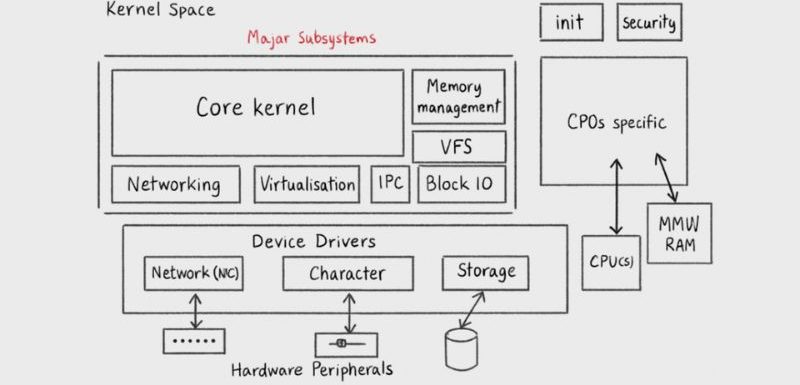
Every Linux operating system is built on top of the Linux kernel. It serves as a link between software and hardware, enabling effective communication between applications and the physical resources of the computer. The kernel is essential to preserving system performance, security, and stability whether you use Linux for web hosting, cloud computing, embedded devices, cybersecurity, software development, or enterprise servers. In contrast to standard applications, the kernel runs at the heart of the operating system, handling crucial tasks including memory allocation, file management, networking, device connection, and process execution.
Understanding Linux kernel architecture is valuable for system administrators, software developers, DevOps engineers, cybersecurity professionals, and anyone interested in Linux. It provides deeper insight into how the operating system functions and helps professionals troubleshoot performance issues more effectively. You can also learn through FITA Academy. If you are planning to build a career in Linux administration or system engineering, enrolling in Linux Training can provide practical knowledge of kernel architecture, system management, and real-world Linux administration.
What Is Linux Kernel Architecture?
The underlying organization and structure of the Linux kernel that permits hardware and software connection is referred to as Linux kernel architecture. Without directly engaging with hardware, the kernel is in charge of overseeing the system’s essential resources and making sure that programs operate well. By receiving requests from user applications and converting them into hardware actions, it serves as an intermediary layer.
The kernel alone handles low-level system functions, in contrast to a Linux distribution that contains utilities, desktop environments, and software packages. Due to Linux’s monolithic kernel architecture, a number of essential functions, including memory management, file system support, device drivers, and process management, run inside the kernel. By enabling quicker communication between various kernel components, this architecture enhances performance while preserving flexibility through loadable kernel modules. Professionals can better understand Linux’s reputation for speed, dependability, scalability, and security across servers, cloud platforms, embedded devices, and enterprise contexts by comprehending this architecture.
Process Management: Coordinating System Execution
One of the Linux kernel’s most significant duties is process management. On a Linux system, every program functions as a process, and the kernel makes sure that each process has enough CPU time and system resources. It maintains system stability while creating, scheduling, pausing, resuming, and ending processes. The Linux scheduler uses resource availability, fairness, and priority to decide which process should run next. Multitasking is made possible by this scheduling technique, which lets users run numerous apps at once without experiencing appreciable performance reduction. The kernel uses context switching, which quickly shifts CPU control between processes to give the impression of parallel execution when multiple programs vie for processor attention.
In addition, the kernel controls inter-process communication channels, process identifiers, and parent and child processes. While optimizing CPU use, effective process management guarantees that programs stay responsive. You can also learn through Linux Training In Chennai for expert guidance. In high-performance computing systems, cloud infrastructure, and enterprise servers where thousands of processes may run concurrently, this capacity is very crucial.
Memory Management: Optimizing Resource Utilization
The Linux kernel can effectively allocate and arrange system memory thanks to memory management. Memory is necessary for all running applications to store data, carry out calculations, and carry out commands. The kernel keeps applications from interfering with one another while guaranteeing that each process has enough memory. Linux improves system stability and security by giving each process its own private memory area through virtual memory. The kernel uses swap space to temporarily store dormant memory pages on disk, enabling active applications to continue operating effectively even when physical memory becomes constrained.
In order to maximize system performance, the kernel also controls memory allocation, deallocation, caching, and page replacement. Data that is frequently accessed stays in memory caches, which lowers disk access and speeds up applications. Memory security techniques keep sensitive data belonging to other programs out of the hands of unauthorized operations. These advanced memory management strategies allow Linux systems to operate very well in servers, desktop PCs, embedded systems, and cloud computing settings while handling demanding workloads.
Device Drivers and Hardware Management
The Linux kernel may interact with installed hardware components on a computer thanks to device drivers. Devices like keyboards, printers, storage drives, graphics cards, network adapters, USB devices, and audio gear cannot communicate with the operating system without device drivers. A specific driver is needed for every hardware device in order to convert operating system commands into instructions that the hardware can comprehend. One of the most adaptable operating systems on the market, the Linux kernel supports thousands of hardware devices. While some drivers can be dynamically loaded as kernel modules whenever needed, many are integrated right into the kernel.
The kernel controls interruptions produced by connected devices and keeps an eye on hardware activity all the time. For instance, the kernel processes the interrupt and reacts accordingly when a user inserts a USB device or clicks a keyboard key. You can learn it form Training Institute in Chennai with expert guidance. Linux systems may function dependably on a variety of hardware platforms thanks to effective hardware management, which guarantees steady connection between software programs and physical devices.
File System Management and Networking Subsystem
The file system management subsystem of the Linux kernel controls the organization, retrieval, and storage of data. Linux is compatible with a variety of storage devices and operating systems because to its support for many file systems, including ext4, XFS, Btrfs, FAT32, and NTFS. While maintaining data integrity, the kernel manages file creation, deletion, ownership, permissions, directory structures, and storage allocation. Additionally, Linux has a strong permission model that guards against unwanted access to files. Ownership and permission settings that specify who can read, alter, or run particular resources are present in every file and directory.
The networking subsystem facilitates computer-to-computer communication over local and international networks in addition to file management. Network interfaces, sockets, routing tables, firewalls, TCP/IP protocols, and packet transfer are all managed by the kernel. Linux computers may act as web servers, cloud platforms, database servers, and network infrastructure devices because to these networking features. Networking and file system administration work together to provide contemporary enterprise computer environments.
Why Understanding Linux Kernel Architecture Matters
IT professionals working in system administration, software development, cybersecurity, cloud computing, and embedded systems can greatly benefit from having a solid understanding of Linux kernel design. This is how to choose between linux and windows your needs. Professionals may more effectively debug performance bottlenecks and optimize system resources by understanding how the kernel handles programs, memory, hardware, and networking. System administrators can monitor system performance, assess resource utilization, and fix hardware compatibility problems by using their knowledge of the kernel. Writing programs that effectively utilize operating system resources is advantageous to software developers. Cybersecurity experts learn more about attack prevention strategies, privilege management, and kernel-level security features.
While embedded system developers tailor Linux kernels for specific hardware platforms, cloud engineers use kernel optimization to optimize virtual machine performance. Professionals with kernel expertise become key assets capable of managing safe, dependable, and high-performing computing environments as enterprises depend more and more on Linux-powered servers and cloud infrastructure.
Best Practices for Learning Linux Kernel Architecture
It takes both academic knowledge and real-world experience to learn Linux kernel architecture. Before delving into more complex kernel ideas, novices should first establish a solid foundation in Linux commands, file systems, shell scripting, and system administration. Understanding how various kernel subsystems function can be gained by reading the official Linux kernel documentation. Students can safely explore without interfering with production systems by setting up virtual machines. Through hands-on observation, theoretical principles are reinforced through kernel module exploration, process information viewing, memory consumption monitoring, and system log analysis. Studying open-source kernel code exposes students to practical software engineering techniques and enhances their comprehension of Linux internals.
Learning is greatly accelerated by taking part in Linux groups, working on open-source projects, and talking about technical ideas with seasoned experts. Frequent practical experience with kernel setup, performance monitoring tools, and troubleshooting. Exercises fosters technical proficiency and confidence. Enrolling in a Linux course will help you build industry-ready Linux administration and kernel management abilities. If you’re looking for structured instruction and hands-on experience.
Conclusion
The Linux kernel, which controls all crucial hardware-software interactions, is the central component of the Linux operating system. Process management, memory management, device drivers, file system management, and networking. Are some of the key elements that make up its architecture. When combined, these elements guarantee dependable hardware functioning. Secure communication, stable application performance, and effective resource use.
Gaining an understanding of Linux kernel design is more than just a theoretical exercise; it gives professionals the skill. They need to efficiently manage enterprise Linux environments, enhance performance, strengthen security, and troubleshoot systems. Learning Linux kernel architecture offers a solid technical foundation that supports long-term job progression. Regardless of your career goals system administration, DevOps, cybersecurity, cloud computing, or embedded systems. You can gain the knowledge necessary to operate with confidence. On one of the most potent and popular operating systems in the world through ongoing education, practical application, and real-world experience.